
TFP Expert Motorcycle After-Sales Technician (TEAVM)
24-month work-study program | RNCP 40854
Upon completion of the training, the work-study students will be able to:
Perform maintenance tasks on internal combustion engines and peripheral equipment, as well as all vehicle driving, comfort, and safety systems.
The holder of this certification serves as the technical advisor for the after-sales service department.
In this capacity, he or she provides technical support and training.
Qualification Content
Technical activities
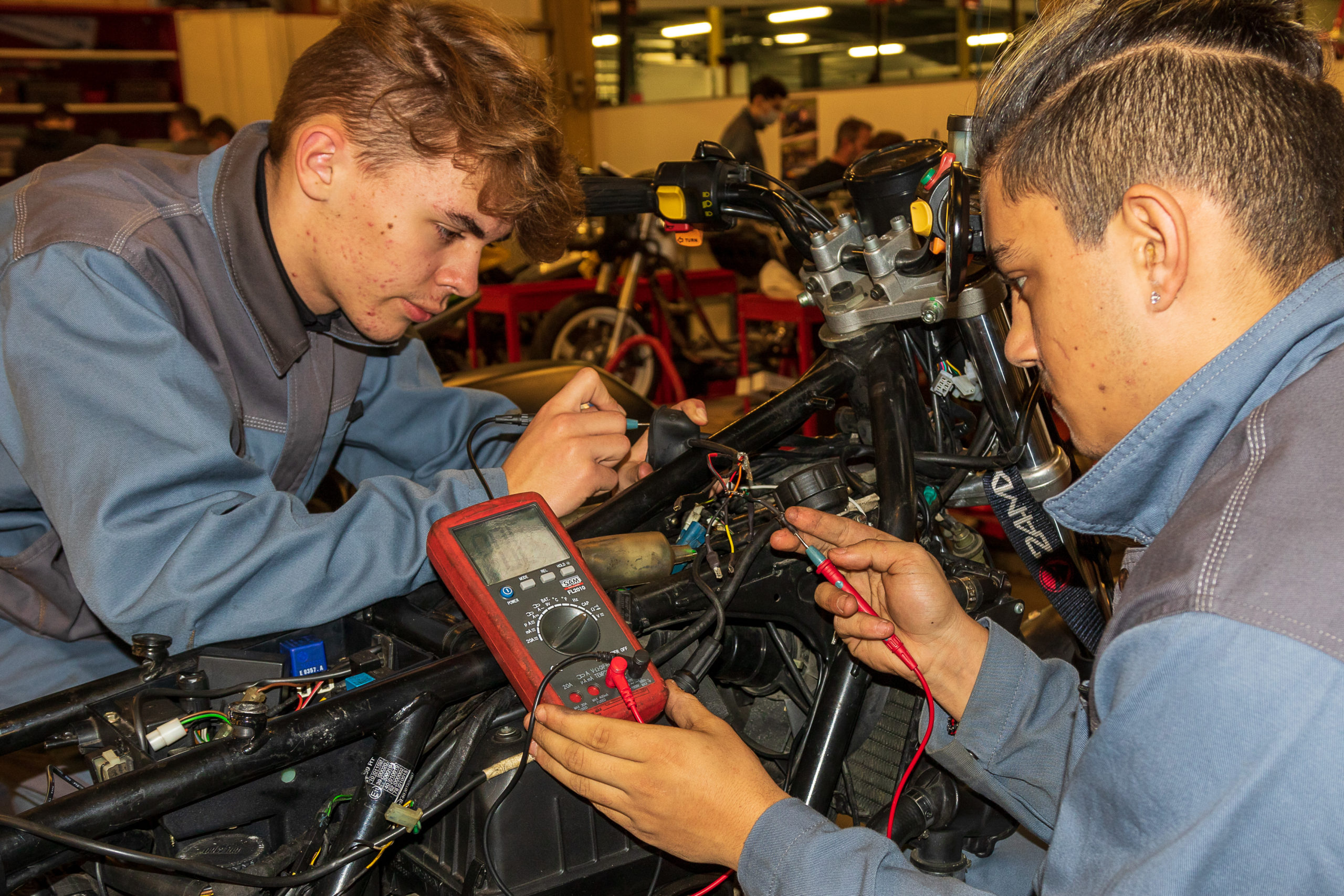
– All preventive and corrective maintenance work on vehicles, including: internal combustion engines and related equipment; mechanical assemblies; and electrical, electronic, pneumatic, hydraulic, and optical systems that ensure the vehicle’s drivability, comfort, and safety.
– Installation of vehicle accessories.
The maintenance operations mentioned above require a thorough understanding of procedures and the identification of steps related to:
– Diagnostic testing,
– Performing inspections, adjustments, and tests.
They also require the ability to interpret physical quantities, as well as proficiency in the use of equipment and diagnostic and control methods, including remote ones.
MaintenanceOrganization and Management
Maintenance Organization
– Liaising with the manufacturer’s and/or equipment supplier’s departments: receiving and transmitting technical information
,
– Updating and filing technical documentation,
– Planning maintenance work,
– Setting up and maintaining the workstation and tools,
– Applying the company’s current quality procedures.
Maintenance Management
– Providing technical and usage advice to customers,
– Preparing all necessary workshop documents,
– Preparing quotes, work orders, etc.,
– Occasionally assisting the receptionist with customer reception and vehicle handover procedures. Technical Training Role
– Conducting technical training sessions for after-sales service staff,
– Participating in the development of the company’s training plan / mentoring young people in work-study programs,
– Technical support for service department staff
– Customer reception and vehicle handover
– Inspection and repairs of the chassis and suspension
– Assignment, monitoring, and oversight of tasks assigned to staff.
Find all the official information on France Compétences
Unique in France – Competition Module
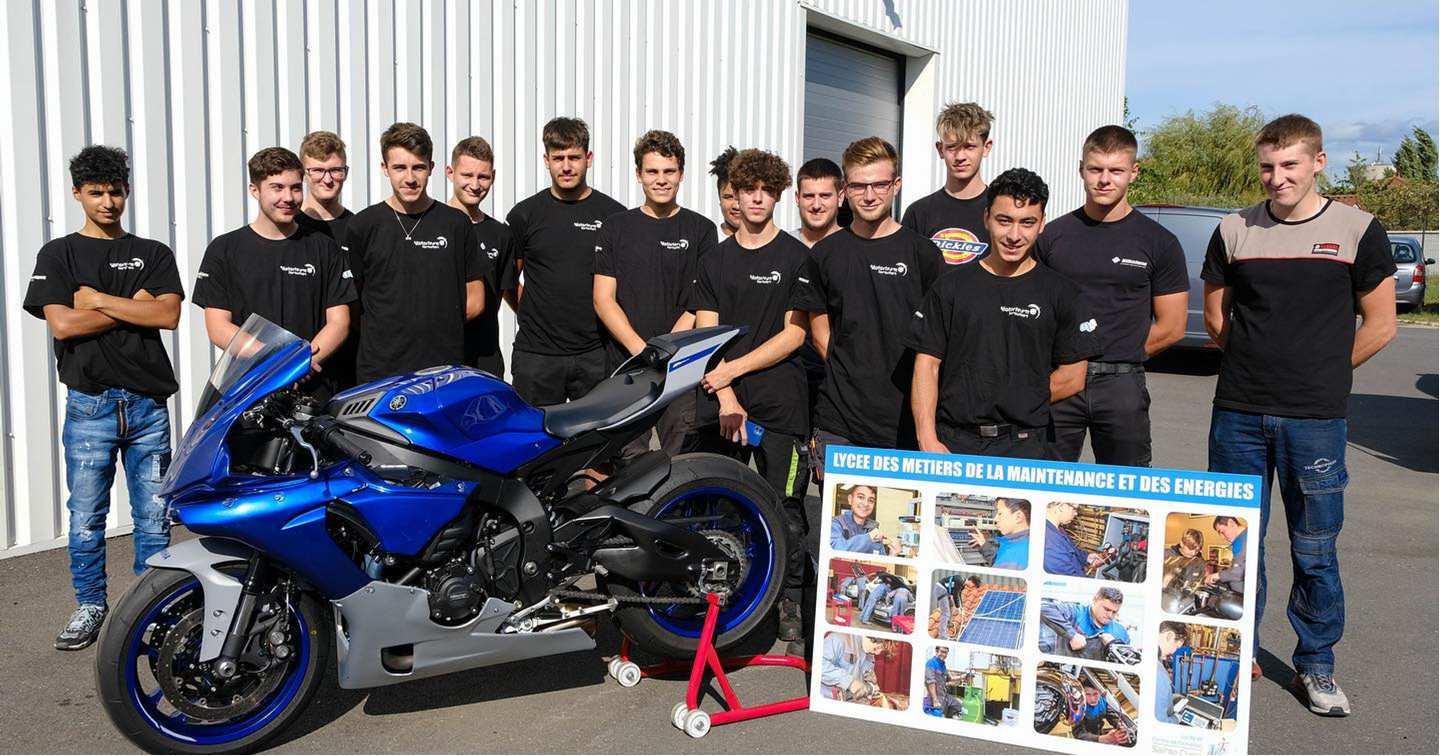
The TFP TEAVM training program has been a real success with our students thanks to its competition-focused approach. By partnering
with a motorcycle racing club, we offer a unique immersion in a high-performance environment. Students can
thus apply their theoretical knowledge in diagnostics, inspection, repair, and equipment upgrades in real-world, demanding situations
.
The world of motorsports demands a keen focus on the needs of drivers and the ability to find quick and
effective solutions to ensure their performance and safety. This hands-on experience allows for the development of advanced technical
skills in several areas, such as chassis and suspension, powertrain, and onboard electronics.
A deep understanding of the dynamics of competition—based primarily on motorcycle setup—and the ability to
solve complex problems under pressure are also developed. Furthermore, this approach fosters the development of essential qualities
such as precision, responsiveness, and teamwork. Our technicians thus become not only competent, but
also ready to excel in a variety of settings and meet the high demands of the motorcycle market.
This partnership with Moto Club Bourbonnais Racing is therefore a real asset, ensuring top-quality training and enhanced career prospects
for our graduates. This year, Moto Club Bourbonnais Racing will give students the opportunity to put their skills into practice
on motorcycles that Honda France has agreed to provide us with, as we prepare 125 CB bikes for the Honda
Challenge, which will take place on June 28 and 29, 2025.
Target Audience & Prerequisites
For all ages
Entry requirement: Level 4 (high school diploma)
Be between the ages of 15 and 29 (exceptions may apply). There are no age restrictions for individuals who are: recognized as workers with disabilities; planning to start or take over a business that requires the degree; or listed as elite athletes.
Program:
Technical Activities:
– Preventive and corrective maintenance
– Installation of vehicle accessories
– Diagnostic testing
– Performing inspections, adjustments, and tests
Maintenance Organization and Management:
– Maintenance organization
– Maintenance management
– Technical training
Specific Qualifications of a Motorcycle After-Sales Service Technician.
Duration and cost of the training *
- 651 hours at a training center
- Work-study program: see the schedule available here
- Cost:Free, paid trainingfor the apprentice; funding provided by OPCO or the Public Service
- Start of the program: September 2025
Estimated duration and work-study schedule, which can be adjusted based on the company’s needs and the learner’s prerequisites.
Career paths, professions, jobs
Business sectors:
This position is most commonly found in small and medium-sized enterprises that regularly perform motorcycle maintenance.
Types of jobs available:
– Diagnostic Technician
– Workshop Team Leader
– Workshop Manager
– Workshop Foreman
– Motorcycle Team Leader
– Workshop Supervisor
– After-Sales Customer Advisor
Level corresponding to the main content of the qualification: 12
Further education:
The TFP is designed to facilitate rapid entry into the workforce, but students can pursue additional training after completing the program:
:
– Professional Bachelor’s Degree in Automotive Services Organization and Management,
– TFP in After-Sales Service Receptionist,
– Bachelor of Science in Mechatronics Engineering, specializing in Process Engineering and Vehicle Support.
| Number of participants | 16 |
| Exam Success Stories | 87.5% |
| Failures Exam |
2 |
| Withdrawals during training | 0 |
| Integration into the workforce | 16 |
| Further education | 0 |
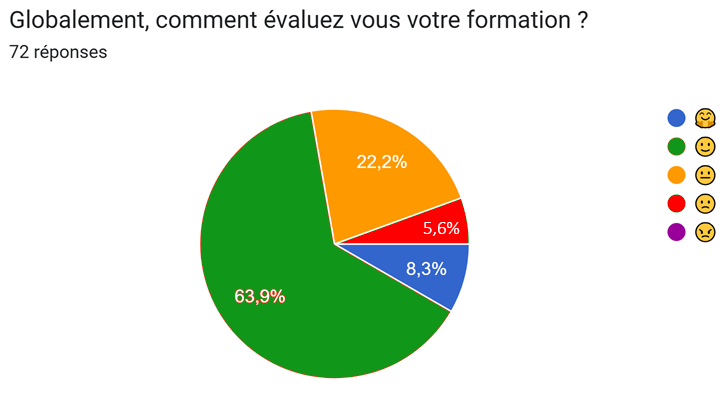
Overall satisfaction of BTS students with their program:
Assessment Criteria
Learning outcomes are assessed through theoretical and practical assessments throughout the training program, and a progress report is compiled.
A l’aide de l’entretien de narration d’activité, le jury décide d’attribuer ou non le TFP au candidat.
Teaching and technical resources:
Training based on a work-study program, with classroom sessions supplemented by workplace placements, the objectives of which were defined at the start of the program.
They rely on active and participatory teaching methods to build confidence, stimulate a desire to learn, enhance independence, and encourage interaction.
The training takes place in our technical workshops dedicated to the motorcycle industry.
Providing educational materials, conducting case studies, role-playing exercises, and hands-on activities.
Classroom instruction takes place in standard classrooms.
Professional automotive maintenance software: Atelier Doc, Atelier Chiffrage…
Vocational courses are held in technical workshops equipped with specialized equipment and tools for vehicle maintenance (such as scissor lifts, toolboxes, air compressors, rolling jacks, tire changers, wheel balancers, diagnostic tools, and front-end alignment machines).
A computer lab equipped with 14 computers is available for conducting technological research.
A "traditional" classroom is also used whenever necessary.
Instructor Profiles
An experienced multidisciplinary team of National Education staff who are thoroughly familiar with the objectives of the program.
Your advisor, an expert in vocational training, who oversees your on-campus studies and provides support during your workplace placements
Terms of Access
Admission following an individual interview, verification of prerequisites, and review of funding options.
This training program is open to candidates who have obtained one of the following certifications in the field of automotive maintenance (passenger cars or light commercial vehicles, as applicable):
– Vocational Baccalaureate in Vehicle Maintenance, Option A: Passenger Cars
– Vocational Certificate: Expert Automotive After-Sales Technician
– Vocational Baccalaureate in Vehicle Maintenance, Option C: Motorcycles
– Vocational Baccalaureate in Vehicle Maintenance, Option B: Road Transport Vehicles
– TFP: Expert After-Sales Technician for Commercial and Industrial Vehicles;
Either by a direct decision of the company’s manager, based on the employee’s skills as assessed against the requirements of the certification.
The program begins in September; enrollment outside of this period is possible and will be considered on a case-by-case basis to ensure compliance with regulatory requirements and the exam guidelines.
Final enrollment is contingent upon signing an apprenticeship contract with a company whose field of activity corresponds to the intended trade.
In-person training is available to people with disabilities following an individualized assessment of the necessary accommodations. Disability Coordinator: Ms. CHIPIER, 0477505100
This program is also available in a modified and/or streamlined format for those who hold an equivalent degree in another field.
Find all the performance metrics for our training programs on the INSERJEUNES website
Located in Sury-le-Comtal, in the heart of the Forez Plain and within an employment area that aligns with the training programs offered there, the CFA Sainte-Claire is easily accessible from throughout the Auvergne-Rhône-Alpes region thanks to the Loire’s extensive intercity transportation network.
You will complete your training in a 4,500-square-meter facility equipped with state-of-the-art technical training spaces. The CFA also features a dormitory with 84 beds that can accommodate students from all over France, as well as a self-service cafeteria offering breakfast, lunch, and dinner.
Demonstrated competencies and assessment methods:
RNCP36605BC01 – Inspection and Repair of Engine Management Systems
| List of skills | Assessment Criteria |
|---|---|
|
Testing/repair scenario on:
and
|
RNCP36605BC02 – Diagnosis of Engine Management Systems
| List of skills | Assessment Criteria |
|---|---|
|
Diagnostic scenario on:
and
|
RNCP36605BC03 – Maintenance of Motorcycle Mechanical Systems
| List of skills | Assessment Criteria |
|---|---|
|
Practical exercise on the inspection and repair of a removed engine (GMP) And Practical exercise on inspecting and servicing the braking system and chassis components |
RNCP36605BC04 – Diagnosis of Motorcycle Mechanical Systems
| List of skills | Assessment Criteria |
|---|---|
|
Case study that allows for:
|
RNCP36605BC05 – Diagnosis, inspection, and replacement of electronic/multiplexed control systems in motorcycles
| List of skills | Assessment Criteria |
|---|---|
|
|
RNCP36605BC06 – Customer Relations in Motorcycle Repair Shops
| List of skills | Assessment Criteria |
|---|---|
|
For maintenance or repair work: Scenario:
and
|
RNCP36605BC07 – Planning of motorcycle workshop services
| List of skills | Assessment Criteria |
|---|---|
|
Case study/questionnaire designed to assess the candidate’s ability to plan operations while taking into account human and technical resources. |
RNCP36605BC08 – Transfer of technical knowledge and skills
| List of skills | Assessment Criteria |
|---|---|
|
Case study aimed at identifying the methods and resources needed to organize technical training for employees |
Description of the procedures for obtaining certification through the accumulation of skill modules and/or through distance learning:
The TFP is awarded by a joint panel consisting of an employer representative, an employee representative, and an instructor who did not participate in the candidate’s coaching or training. – The panel reviews all candidates once they have been assessed on all the competency modules that make up the TFP and have successfully completed at least seven competency modules.
Monitoring procedures:
The program is based on teaching methods that focus on individualized instruction.
We have chosen an educational strategy aimed at:
- Tailor learning paths by offering each person a personalized learning path,
- Fostering independence by empowering our trainees to take an active role in their learning,
- Develop a culture of technology by incorporating all aspects, including those related to workplace safety,
- Develop professional attitudes, methods, and rigor.
- Course modules and individualized case studies are assessed by the lead instructor through collaborative work in small groups.
- Practical training sessions are evaluated individually by the supervising instructor, who records the results in a skills portfolio.
- Supervised study sessions for assignments and practical work are also scheduled to help students prepare for the exam
- A computer lab is available for preparing the internship and work activity report, which is required to pass the TFP.