
BTS Systems Maintenance Option B: Energy and Fluid Systems
2-year apprenticeship | RNCP36968
Depending on the size and structure of the industrial company, the BTS graduate is responsible for coordinating maintenance work and liaising with external contractors. In particular, they work on facilities, whether they are located on a single site or spread across a wider area.
His expertise in the operation and structure of production systems makes him a key point of contact for both operators and decision-makers.
The senior technician performs a variety of tasks, including troubleshooting, commissioning, and operating systems. He or she works on systems that combine a wide range of technologies, drawing on a broad base of knowledge, particularly regarding scientific laws and principles.
When troubleshooting, they must conduct a thorough analysis to determine the cause of the problem. For small installations, they advise the customer on appropriate solutions and provide a quote for the work to be performed. During commissioning or startup, their role is to optimize the settings.
The maintenance technician plays a key role in implementing the company’s overall safety policy. In all professional activities inherent to the job, they will be required to participate, at their level, in the analysis of occupational risks by identifying hazards to their own health and safety as well as to that of others, while safeguarding company property. These contributions will be documented and will enable the updating of the single safety document; they will also be required to implement the general principles of occupational risk prevention and emergency response.
Find all the official information on France Compétences
Target Audience & Prerequisites
- A person under the age of 30
- Employee
- Employee undergoing retraining
- Job seeker
Meets one of the criteria:
BAC STI in Mechanical Engineering (Option B), STI in Electrical Engineering, STI in General Mechanical Engineering, BAC S, or BAC PRO in Automotive Maintenance; or proof of 3 years of professional experience in the relevant field.
Terms of Access
ACADEMIC: Preliminary admission following approval of the PARCOURSUP application in accordance with the prerequisites specified on the platform; final admission upon signing the apprenticeship or vocational training contract.
EMPLOYEE/JOB SEEKER: Following an individual interview, verification of prerequisites, and an assessment of funding options.
The school year begins in September of each year.
The program remains open for enrollment throughout the year on a placement basis, subject to review of the applicant’s academic record.
In-person training is available to people with disabilities following an individualized assessment of the necessary accommodations. Disability Coordinator: Ms. CHIPIER, 0477505100
This program is also available in a modified and/or streamlined format for those who hold an equivalent degree in another field.
Duration and cost of the training *
Apprenticeship Training
- Duration:2 years │ 675 hours of training per year
- Work-study program: 2 weeks at a company | 2 weeks at a training center
- Cost: €10,571 covered by OPCO. Apprentice’s out-of-pocket cost: €0
Estimated duration and work-study schedule, which can be adjusted based on the company’s needs and the learner’s prerequisites.
Career paths, professions, jobs
Business sectors:
- All types of businesses
Types of jobs available:
- Maintenance Technician
Further education:
- Bachelor’s Degree in Industrial, Production, and Energy Systems Maintenance
- Bachelor's Degree in Maintenance and Technology: Industrial Control
- Bachelor's Degree in Maintenance and Technology: Maintenance Planning
- Bachelor's Degree in Maintenance and Technology: Multidisciplinary Systems
- Preparatory Course for the ATS in Industrial Engineering
Program:
General Education
– Mathematics
– Physical Sciences
– English
– General Culture and Expression
TechnicalEducation
– Structural and Functional Analysis
– Maintenance Strategy, Intervention, and Organization
– Electrical Engineering
– Automation
– Information Systems
– Health, Safety, and Environment
Assessment Criteria
Learning outcomes are assessed through theoretical and practical assessments throughout the training program, and a progress report is compiled.
The final assessment is a theoretical and practical exam taken at the end of the second year, leading to the award of the Brevet de Technicien Supérieur.
Each competency module is certified and involves an assessment and validation. Successful completion of all modules leads to the award of the Brevet de Technicien Supérieur.
Teaching and technical resources:
Teaching methods and resources: practical exercises, real-world case studies, and comparing activities carried out in the workplace with those conducted at the training center.
Educational systems dedicated to energy maintenance, positive and negative cold rooms, air conditioners, reversible air-to-water heat pumps, solar thermal collectors, oil, gas, and wood pellet boilers, cogenerators, water treatment systems, science laboratory
Success indicators for the 2023–2024 academic year:
| Number of participants | 14 |
| Exam Success Stories | 100% |
| Failures Exam |
0 |
| Withdrawals during training | 0 |
| Integration into the workforce | 6 |
| Further education | 6 |
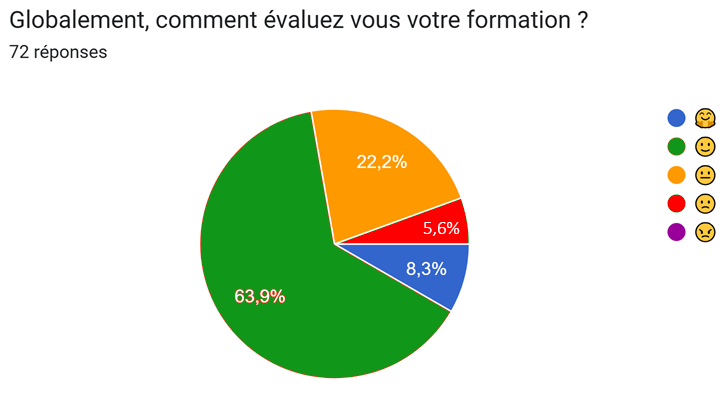
Overall satisfaction of BTS students with their program:
Find all the performance metrics for our training programs on the INSERJEUNES website
Located in Sury-le-Comtal, in the heart of the Forez Plain and within an employment area that aligns with the training programs offered there, the CFA Sainte-Claire is easily accessible from throughout the Auvergne-Rhône-Alpes region thanks to the Loire’s extensive intercity transportation network.
You will complete your training in a 4,500-square-meter facility equipped with state-of-the-art technical training spaces. The CFA also features a dormitory with 84 beds that can accommodate students from all over France, as well as a self-service cafeteria offering breakfast, lunch, and dinner.
Monitoring procedures:
The program is based on teaching methods that focus on individualized instruction.
We have chosen an educational strategy aimed at:
- Tailor learning paths by offering each person a personalized learning path,
- Fostering independence by empowering our trainees to take an active role in their learning,
- Develop a culture of technology by incorporating all aspects, including those related to workplace safety,
- Develop professional attitudes, methods, and rigor.
- Course modules and individualized case studies are assessed by the lead instructor through collaborative work in small groups.
- Practical training sessions are evaluated individually by the supervising instructor, who records the results in a skills portfolio.
- Supervised study sessions for assignments and practical work are also scheduled to help students prepare for the exam
- A computer lab is available for preparing the internship and work experience report, which is required for graduation from the BTS program
Skills and assessment methods:
RNCP36968BC01 – Corrective Maintenance
| List of skills | Assessment Criteria |
|---|---|
|
– Implement an investigative plan – Restore the functionality of a property – Put a property into service and/or take it out of service |
Students (public or private schools under contract), Apprentices (accredited vocational training centers or apprenticeship programs), Continuing vocational education (accredited public institutions). SBB
Continuing professional education (public institutions authorized to administer the CCF for this BTS). SBB
Students (at private schools not under contract with the state), Apprentices (at CFA training centers or non-accredited apprenticeship programs), Continuing vocational education (at non-accredited institutions) based on their professional experience, Distance learning. Practical and timely |
RNCP36968BC02 – Preventive Maintenance
| List of skills | Assessment Criteria |
|---|---|
|
– Analyze risks – Implement appropriate preventive measures – Perform preventive maintenance – Communicate in writing |
Students (public or private schools under contract), Apprentices (accredited vocational training centers or apprenticeship programs), Continuing vocational education (accredited public institutions). SBB
Continuing professional education (public institutions authorized to administer the CCF for this BTS). SBB
Students (at private schools not under contract with the state), Apprentices (at CFA training centers or non-accredited apprenticeship programs), Continuing vocational education (at non-accredited institutions) based on their professional experience, Distance learning. Practical and timely |
RNCP36968BC03 – Preventive Maintenance
| List of skills | Assessment Criteria |
|---|---|
|
– Identify improvement solutions – Carry out work – Communicate verbally |
Students (public or private schools under contract), Apprentices (accredited vocational training centers or apprenticeship programs), Continuing vocational education (accredited public institutions). Oral exam
Continuing professional education (public institutions authorized to administer the CCF for this BTS). Oral exam
Students (at private schools not under contract with the state), Apprentices (at CFA training centers or non-accredited apprenticeship programs), Continuing vocational education (at non-accredited institutions) based on their professional experience, Distance learning. Oral exam |
RNCP36968BC04 – Property Registration
| List of skills | Assessment Criteria |
|---|---|
|
– Understand the functional, structural, and temporal organization of a property – Describe the power and information chain |
Students (public or private schools under contract), Apprentices (accredited vocational training centers or apprenticeship programs), Continuing vocational education (accredited public institutions). Written notice
Continuing professional education (public institutions authorized to administer the CCF for this BTS). CCF
Students (at private schools not under contract with the state), Apprentices (at CFA training centers or non-accredited apprenticeship programs), Continuing vocational education (at non-accredited institutions) based on their professional experience, Distance learning. Written notice |
RNCP36968BC05 – Maintenance Planning
| List of skills | Assessment Criteria |
|---|---|
|
– Analyze maintenance metrics – Plan an activity – Organize maintenance activities |
Students (public or private schools under contract), Apprentices (accredited vocational training centers or apprenticeship programs), Continuing vocational education (accredited public institutions).
CCF
Continuing professional education (public institutions authorized to administer the CCF for this BTS). CCF
Students (at private schools not under contract with the state), Apprentices (at CFA training centers or non-accredited apprenticeship programs), Continuing vocational education (at non-accredited institutions) based on their professional experience, Distance learning. Practical and timely |
Description of the procedures for obtaining certification through the accumulation of skill modules and/or through distance learning:
The certification framework is organized into units that together form a coherent set of skills and knowledge aligned with the purpose of the degree. It may include units that are optional. Each unit corresponds to a set of skills and an assessment.
Candidates register for the diploma exam. Those who have prepared for the diploma through continuing professional education or the recognition of prior learning automatically receive, for the diploma units in which they earned a grade of 10 out of 20 or higher or for which prior learning was recognized, a certificate recognizing the acquisition of the competencies comprising these diploma units, and thus the corresponding competency blocks. Those who have prepared for the diploma through another pathway receive this certificate upon request.
The diploma is awarded to candidates who achieve an average score of at least 10 out of 20 on all exams. Candidates who have already completed certain skill modules may be exempt from the corresponding exams.