
PROFESSIONAL CERTIFICATE Automotive Maintenance Mechanic| rncp38101
The automotive repair technician performs all routine maintenance tasks in accordance with the manufacturer's recommendations. He or she replaces mechanical components and parts related to the suspension, transmission, and powertrain.
He or she also works on the vehicle to replace mechanical components of the visibility and signaling systems or to install plug-and-play accessories.
He or she works on all types of passenger vehicles designed to carry nine people or fewer and on cargo vehicles with a gross vehicle weight rating of less than 3.5 tons. These vehicles are primarily powered by internal combustion engines.
The professional performs tasks based on verbal instructions or written work orders, under the supervision of a supervisor to whom he or she reports on the work completed.
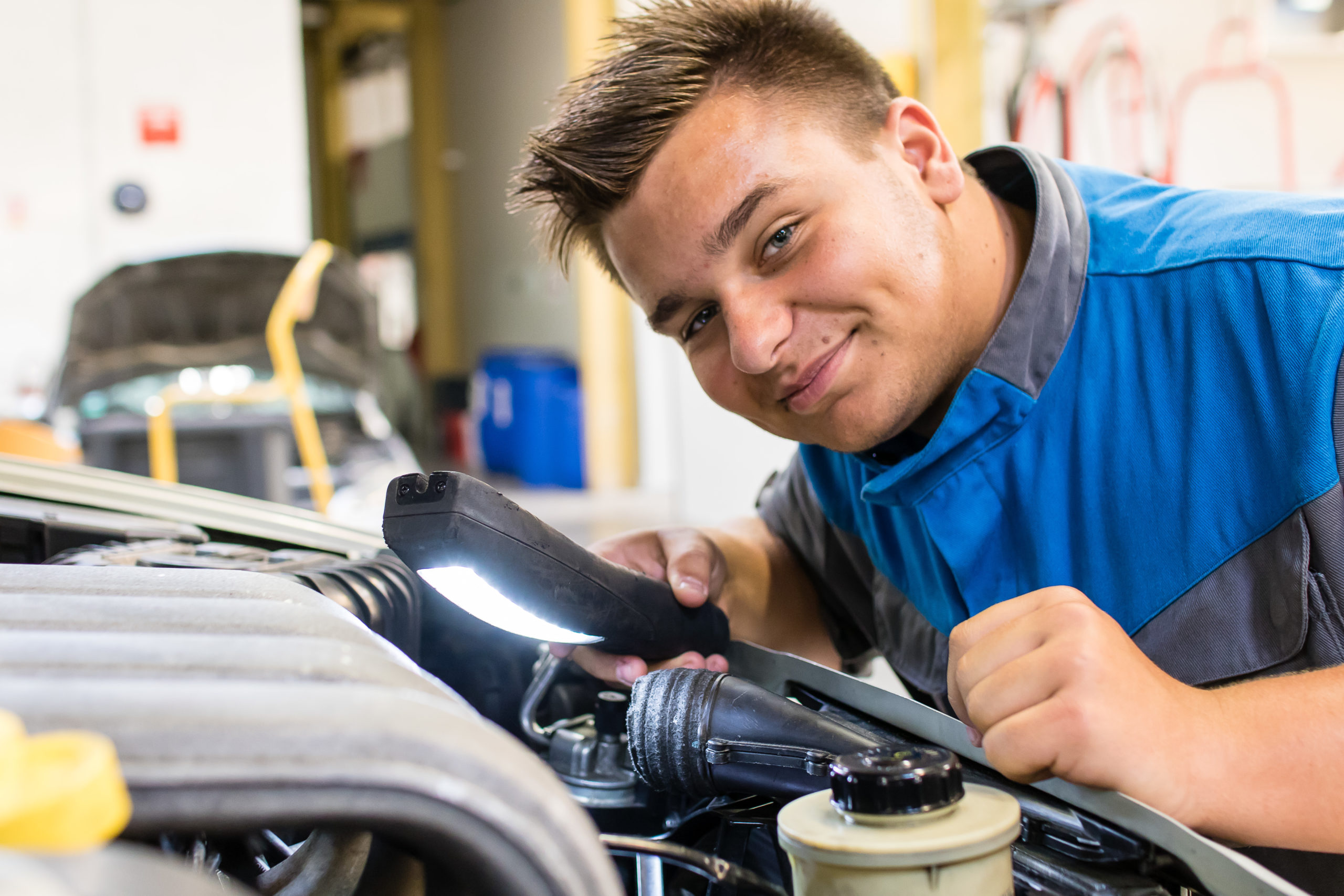
The job is typically performed in a workshop. Work postures range from standing at a workbench or machine to crouching or even lying down for certain tasks inside the vehicle. Good manual dexterity is required.
Work schedules may sometimes require adjustments to ensure service continuity.
Noise levels can be high, but only for short periods.
Handling heavy loads is sometimes necessary.
Handling special industrial waste is common. It requires handling precautions as well as the use of personal protective equipment appropriate for the products being handled.
Find all the official information on France Compétences
Target Audience & Prerequisites
– General audience
– 9th grade level
– A solid grasp of basic skills (reading, writing, and arithmetic), the four basic arithmetic operations, and units of measurement is required.
Terms of Access
Submission of a cost estimate to the funding agency following attendance at a group information session and an individual assessment interview to verify eligibility requirements.
Final admission is subject to approval by the referring institution/funding body; please allow 1 to 2 months before the start of the program.
The course is available as a continuing education program.
The current session is in progress. For information about the next session, scheduled for late 2025, please contact us.
To find out the dates of the group information session for the next session, please contact us at 0477505102.
Training courses are accessible to people with disabilities following a feasibility study of the necessary accommodations.
Disability Coordinator: Ms. CHIPIER 0477505100
Duration and cost of the training *
Continuing Education Program
- Duration: Up to 945 hours at a training center
- Internships: 210 hours
- Cost: €9,450 per person for a group of 12 people. Funding may be available through the CPF or other funding sources (OPCO, regional authorities, etc.). Custom quotes available upon request.
Estimated duration and work-study schedule, which can be adjusted based on the company’s needs and the learner’s prerequisites.
Career paths, professions, jobs
Business sectors:
– Automotive retail and repair.
– Wholesale trade and trade intermediaries.
– Land transportation.
– Public administration and local government.
Types of jobs available:
– Quick Service Technician.
– Automotive Maintenance Mechanic.
With significant experience:
– Specialist Quick Service Technician.
– Automotive Mechanic.
Key Metrics for the 2024 Sessions
| Number of participants | 9 |
| Exam Success Stories | 9 |
| Failures Exam |
0 |
| Withdrawals during the race | 0 |
| Transition to the workforce after completing a training program | 3 |
Links to other professional certifications
Proven skills:
1. Perform routine maintenance, replace tires and brake system components on motor vehicles:
Perform routine maintenance on a motor vehicle.
Replace tires and brake system components.
Work on an automotive air conditioning system.
2. Replace suspension, steering, transmission, signaling, and visibility components on motor vehicles and install connectable accessories:
Replace and adjust steering and suspension components.
Repair damaged mechanical assemblies.
Replace transmission components.
Replace signaling and visibility components; install connectable accessories.
3. Replace the timing system and internal combustion engine of motor vehicles:
Work on an automotive air conditioning system.
Replace the internal combustion engine and its peripheral equipment.
Replace the timing system of the internal combustion engine.
Teaching and technical resources:
The training is provided by CFC instructors and teachers from the Sainte-Claire vocational high school in the school’s technical facilities.
The course content complies with the training guidelines, which are available at the training center.
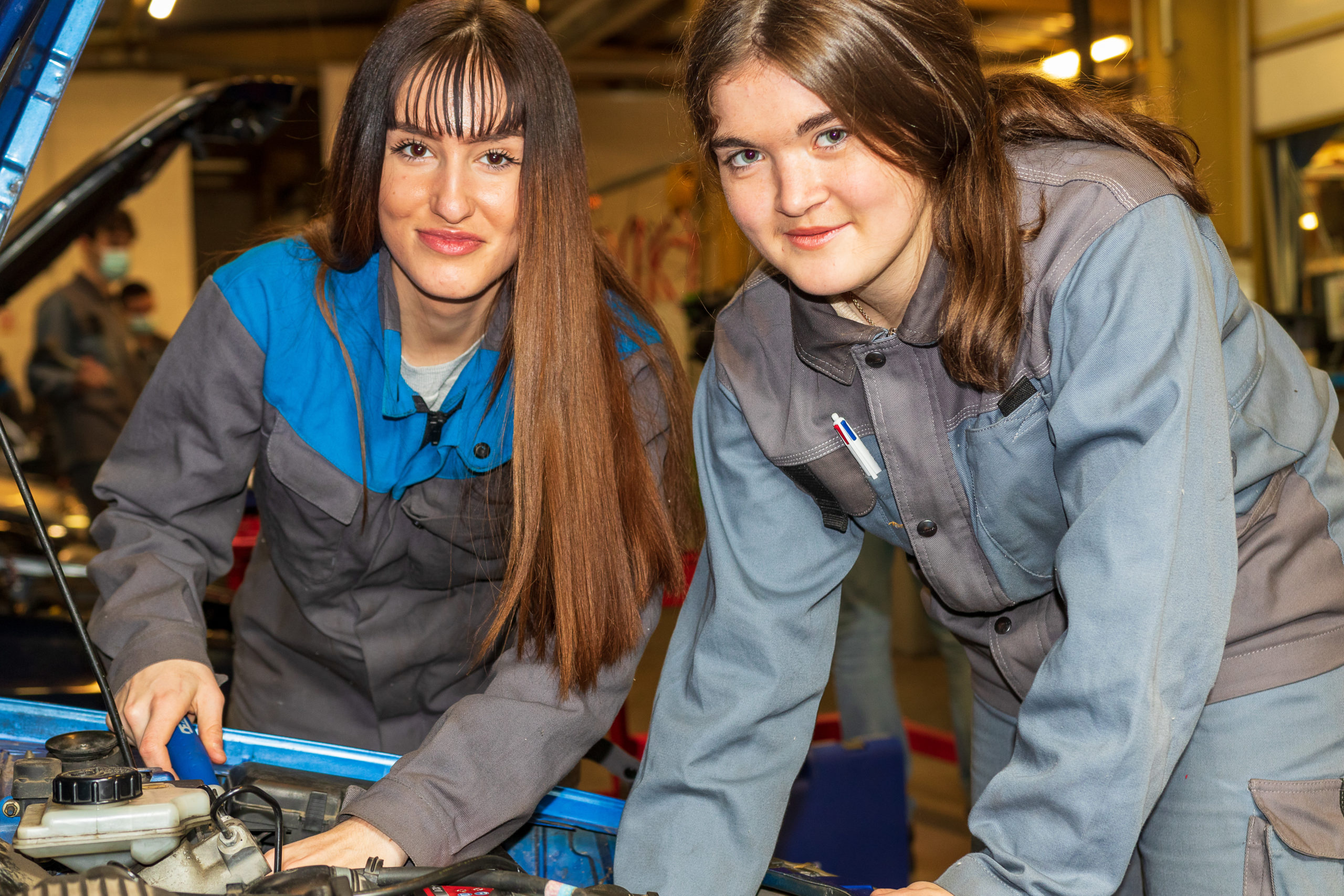
Vocational courses are held in technical workshops equipped with specialized equipment and tools for vehicle maintenance (scissor lifts, toolboxes, air compressors, mobile jacks, tire changers, wheel balancers, diagnostic tools – (KTS BOSCH/CLIPS RENAULT/DMS PEUGEOT), and front-end alignment equipment.
Classroom instruction takes place in standard classrooms; a computer lab equipped with 14 PCs is available for conducting technical research using professional automotive maintenance software such as Atelier Doc and Atelier Chiffrage…
Located in Sury-le-Comtal, in the heart of the Forez Plain and within an employment area that aligns with the training programs offered there, the CFC Sainte-Claire is easily accessible from throughout the Auvergne-Rhône-Alpes region thanks to the Loire’s extensive intercity transportation network.
You will complete your training in a 4,500-square-meter facility equipped with state-of-the-art technical labs for vocational instruction. The CFC also features a dormitory with 84 beds that can accommodate students from all over France, as well as a self-service and cafeteria-style dining service offering breakfast, lunch, and dinner.
Assessment Criteria
Learning progress is assessed throughout the training program and results in the creation of a skills assessment logbook.
The final evaluation is conducted by the certification board authorized by the relevant regional representative of the Ministry of Labor. The board is composed of professionals in the field covered by the certification. (Art. R 338-6 of the Education Code)
It is based on a professional scenario, technical questions, the presentation of a professional portfolio documenting the candidate’s professional practices during the training program, and the results of evaluations completed during the training program.
Full certification (all competency modules approved by the panel) or partial certification (certain modules approved), followed by the issuance of a professional credential or a certificate of completion for the approved modules.
Demonstrated competencies and assessment methods:
RNCP38101BC01 – Perform routine maintenance, replace tires, and replace components of the braking system on motor vehicles
| List of skills | Assessment Criteria |
|---|---|
|
Work-based scenario: 2 hours 30 minutes The role-play takes place in front of the panel, according to the following procedure: Based on the instructions provided on a worksheet, the candidate will:
To complete each task, the candidate records their observations on the worksheet. Total duration of the exam for the candidate: 2 hours 30 minutes |
RNCP38101BC02 – Replace suspension, steering, drivetrain, signaling, and lighting components on motor vehicles and install connectable accessories
| List of skills | Assessment Criteria |
|---|---|
|
Work-based scenario: 2hours 15 minutes The role-play takes place in front of the panel, according to the following procedure: Based on the instructions provided on a worksheet, the candidate will:
To complete each task, the candidate records their observations on the worksheet. Total duration of the exam for the candidate: 2 hours and 15 minutes |
RNCP38101BC03 – Replacing the timing belt and internal combustion engine components of motor vehicles
| List of skills | Assessment Criteria |
|---|---|
|
Work-based scenario: 2 hours 0 minutes The role-play takes place in front of the panel, according to the following procedure: Based on the instructions provided on a worksheet, the candidate will:
Total duration of the exam for the candidate: 2 hours |
Description of the procedures for obtaining certification through the accumulation of skill modules and/or through distance learning:
The professional qualification consists of three skill modules known as Certificates of Professional Competence (CCP), which correspond to the activities listed above.
The professional qualification may be supplemented by one or more skill sets certified by the supplementary specialization certificates (CCS) mentioned above.
This professional certification may be obtained by accumulating professional competency certificates (CCP) or by completing a training program, in accordance with the provisions set forth in the amended decree of December 22, 2015, issued by the Ministry of Labor regarding the conditions for granting professional certifications.
Monitoring procedures:
The program is based on teaching methods that focus on individualized instruction.
We have chosen an educational strategy aimed at:
Developing autonomy by empowering our trainees to take ownership of their learning,
Developing a culture of technology by integrating all components, including those related to workplace safety,
Developing professional attitudes, methods, and rigor.
Course modules and individualized case studies are assessed by the lead instructor through collaborative work in small groups.
Practical training phases are evaluated individually by the lead instructor, who records the results in a skills tracking booklet.
Supervised time during tutorials and practical training sessions is also scheduled to prepare for the certification.
A computer lab is available for preparing the internship and company activity report.