
BACHELOR'S DEGREE Building Energy and Fluids – BIM Specialization
1-year apprenticeship | RNCP40054
Level 6 Degree (Bachelor's Degree)
Become an expert in smart and sustainable buildings with our Energy Management degree
Get ready for a career in sustainable and smart construction with our Bachelor’s Degree in Building Energy and Fluids – BIM Specialization.
This program, offered in partnership with CNAM, will equip you with the skills to master Building Information Modeling (BIM), optimize the energy performance of buildings, and manage technical projects addressing today’s environmental challenges. Perfect for those passionate about construction, energy efficiency, and innovation!
Understanding BIM and Managing a Project Using a Digital Model
You will learn how to manage a BIM (Building Information Modeling) project. This means you will know how to use a digital model to design, visualize, and coordinate every stage of a building’s construction or renovation. You will discover how to work collaboratively as a team on a single 3D model.
Improving the energy efficiency of buildings
You will learn how to analyze an existing or planned building to improve its thermal and energy performance. You will be able to identify sources of heat loss, propose effective technical solutions, and select the right equipment to make a building more environmentally friendly and cost-effective.
Be proficient in the industry's technical tools and software
The Bachelor's Degree in Building Energy and Fluids – BIM Specialization will introduce you to thermal calculation software (Perrenoud RE 2020) and simulation tools used by building professionals (Revit: 3D modeling). You will learn how to perform a thermal assessment, verify compliance with current thermal regulations (RT), and produce technical documents to validate a project.
Be able to propose innovative technical solutions
Whether for new construction or renovation, you’ll be able to propose technical solutions tailored to environmental challenges: selecting materials and high-performance ventilation, insulation, and heating systems.
You’ll also develop your ability to make realistic technical decisions while adhering to budget constraints and current standards.
Find all the official information on France Compétences
This bachelor's degree program is offered in partnership with CNAM

Admission & Prerequisites
- BTS, DUT, Construction, BTS in Environmental Engineering, DUT in Building Services Engineering, Bachelor’s in Physics (120 ECTS)
- Registration
- One-on-one interview
- No registration or tuition fees
- Admission will be officially confirmed upon the signing of a contract or a certificate.
- Course Coordinator: Laëtitia PLISSON
Terms of Access
ACADEMIC: Provisional admission following review and approval of the application based on the prerequisites; final admission upon signing the apprenticeship or vocational training contract.
The school year begins in September of each year.
The program remains open for enrollment throughout the year on a placement basis, subject to review of the applicant’s academic record.
In-person training is available to people with disabilities following an individualized assessment of the necessary accommodations. Disability Coordinator: Ms. CHIPIER, 0477505100
This program is also available in a modified and/or streamlined format for those who hold an equivalent degree in another field.
Duration and cost of the training *
- Apprenticeship contract or professional training contract (for those over 30) with a duration of 12 months
- 1 week at the CFA – 2 weeks at a company
Training costs covered by OPCO.
Cost to the learner: €0
Estimated duration and work-study schedule, which can be adjusted based on the company’s needs and the learner’s prerequisites.
Career paths, professions, jobs
- Research Analysts in Building Thermal Engineering and Fluid Dynamics
- Building Envelope Engineers
- Project Managers for Energy-Efficient Building Renovations
- Technical Draftsman
- Project Manager, BIM Manager, BIM Coordinator
- Site supervisor for new construction projects involving utilities and energy systems or for energy-efficiency renovation projects
Further education
- Continuing Studies at CNAM: Bachelor of Science in Civil Engineering
- Continuing education outside the CNAM: Transfer programs and entrance exams are available for certain programs:
- – Master’s degree in Energy Engineering or Civil Engineering
- – Bachelor of Science in Sustainable Construction
- – Bachelor of Science in Civil Engineering
- – Bachelor of Science in Building Thermal Engineering
Course units:
- Thermal, Acoustic, Fluid Mechanics
- Heating, Ventilation, and Air Conditioning
- Building Energy Systems
- Innovation in the Construction Industry
- BIM Project Management
- Smart building
Assessment Criteria
Learning outcomes are assessed through theoretical and practical assessments throughout the training program, and a progress report is compiled.
The final assessment is a theoretical and practical exam administered at the end of the training program; it is required to obtain the license.
Each competency module is certified and involves an assessment and validation. Successful completion of all modules leads to the award of the Brevet de Technicien Supérieur.
Teaching and technical resources:
Teaching methods and resources: practical exercises, real-world case studies, and comparing activities carried out in the workplace with those conducted at the training center.
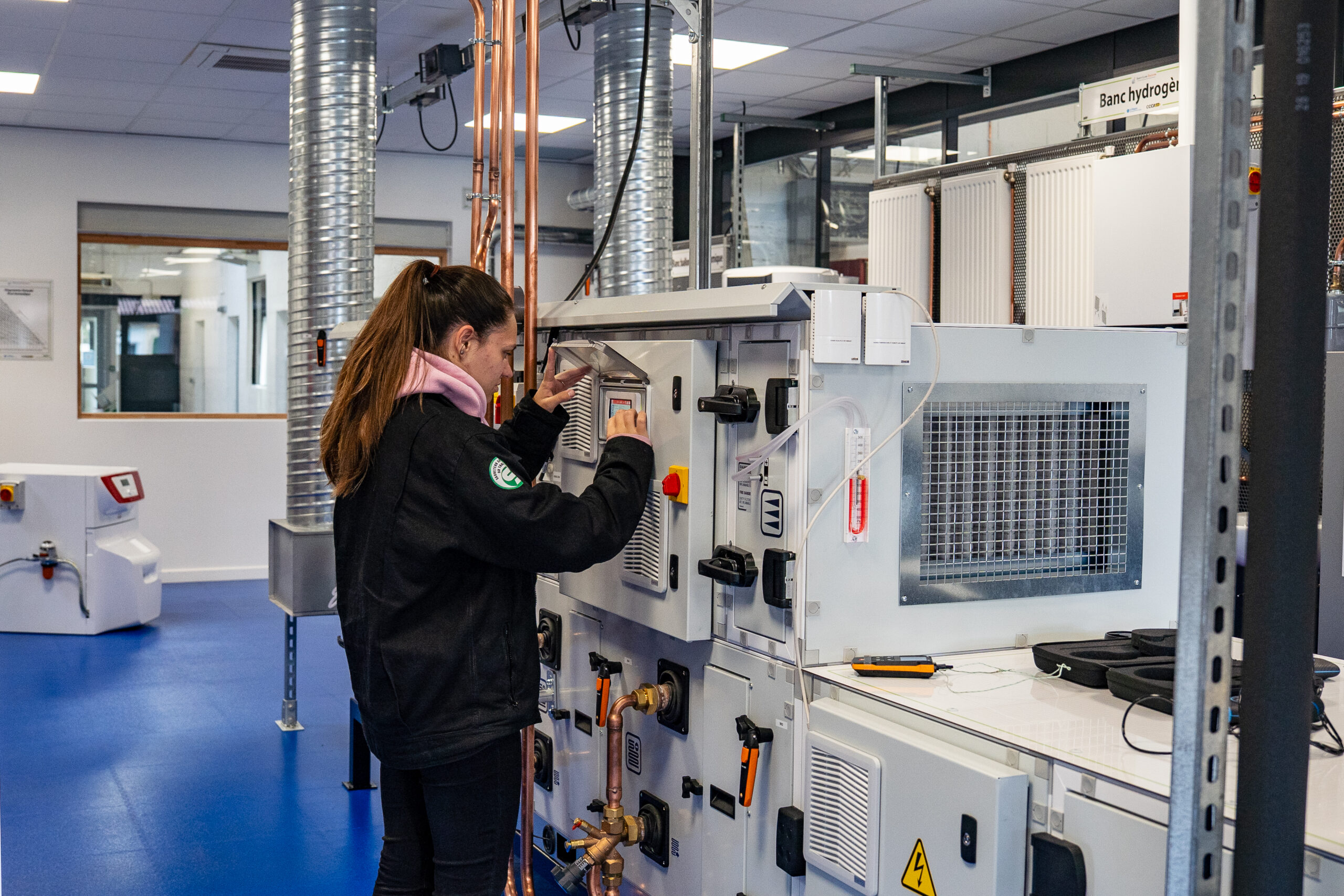
Educational systems dedicated to energy maintenance, positive and negative cold rooms, air conditioners, reversible air-to-water heat pumps, solar thermal collectors, oil, gas, and wood pellet boilers, cogenerators, water treatment systems, science laboratory
Success indicators from the previous session
| Number of participants | NC (Opening in 2026) |
| Exam Success Stories | NC |
| Failures Exam |
NC |
| Withdrawals during training | NC |
| Integration into the workforce | NC |
| Further education | NC |
Find all the performance metrics for our training programs on the INSERJEUNES website
Located in Sury-le-Comtal, in the heart of the Forez Plain and within an employment area that aligns with the training programs offered there, the CFA Sainte-Claire is easily accessible from throughout the Auvergne-Rhône-Alpes region thanks to the Loire’s extensive intercity transportation network.
You will complete your training in a 4,500-square-meter facility equipped with state-of-the-art technical training spaces. The CFA also features a dormitory with 84 beds that can accommodate students from all over France, as well as a self-service cafeteria offering breakfast, lunch, and dinner.
Monitoring procedures:
The program is based on teaching methods that focus on individualized instruction.
We have chosen an educational strategy aimed at:
- Tailor learning paths by offering each person a personalized learning path,
- Fostering independence by empowering our trainees to take an active role in their learning,
- Develop a culture of technology by incorporating all aspects, including those related to workplace safety,
- Develop professional attitudes, methods, and rigor.
- Course modules and individualized case studies are assessed by the lead instructor through collaborative work in small groups.
- Practical training sessions are evaluated individually by the supervising instructor, who records the results in a skills portfolio.
- Supervised study sessions for assignments and practical work are also scheduled to help students prepare for the exam
- An energy laboratory and a CAD/CAM room dedicated to the bachelor's program are being set up.
Skills and assessment methods:
RNCP40054BC01 – Using digital reference tools
| List of skills | Assessment Criteria |
|---|---|
|
Use standard digital tools and IT security policies to collect, process, produce, and disseminate information, as well as to collaborate internally and externally |
Each accredited certifying body implements the assessment methods it deems appropriate: submission of work, practical exercises, project evaluation, etc. |
RNCP40054BC02 – Analyzing Data
| List of skills | Assessment Criteria |
|---|---|
|
– Critically identify and select various resources in one’s field of expertise to research a topic |
Each accredited certifying body implements the assessment methods it deems appropriate: submission of work, practical exercises, project evaluation, etc. |
RNCP40054BC03 – Expressing oneself and communicating orally, in writing, and in at least one foreign language
| List of skills | Assessment Criteria |
|---|---|
|
– Use the various registers of written and spoken French with ease |
Each accredited certifying body implements the assessment methods it deems appropriate: submission of work, practical exercises, project evaluation, etc. |
RNCP40054BC04 – Positioning oneself within a professional field
| List of skills | Assessment Criteria |
|---|---|
|
– Identify and describe the professional fields potentially related to the program’s learning outcomes, as well as possible career paths leading to them |
Each accredited certifying body implements the assessment methods it deems appropriate: submission of work, practical exercises, project evaluation, etc. |
RNCP40054BC05 – Acting responsibly within a professional organization
| List of skills | Assessment Criteria |
|---|---|
|
– Understand one’s role and mission within an organization in order to adapt and take initiative |
Each accredited certifying body implements the assessment methods it deems appropriate: submission of work, practical exercises, project evaluation, etc. |
RNCP40054BC06 – Develop a preliminary design for a project as part of a bid response
| List of skills | Assessment Criteria |
|---|---|
|
– Monitor public and private procurement legislation
|
Each accredited certifying body implements the assessment methods it deems appropriate: submission of work, practical exercises, project evaluation, etc. |
RNCP40054BC07 – Managing civil engineering and construction projects
| List of skills | Assessment Criteria |
|---|---|
|
– Prepare and organize construction sites (site layout, personnel and equipment, specific health and safety plan (PPSPS), reuse, environmental impact) |
Each accredited certifying body implements the assessment methods it deems appropriate: submission of work, practical exercises, project evaluation, etc. |
Description of the procedures for obtaining certification through the accumulation of skill modules and/or through distance learning:
The procedures for obtaining certification through the accumulation of competency blocks and/or distance learning are defined by each certifying body, which implements the methods it deems appropriate: submission of assignments, practical exercises, project evaluations, etc.
These procedures may be adapted depending on the pathway to certification.